

In a beauty market saturated with similar formulas and comparable price points, custom packaging has become one of the clearest ways for a brand to stand apart. Packaging design is no longer a finishing touch applied after a product is developed; it is a strategic decision made early, often in parallel with formulation, because the way a compact looks, opens and feels directly shapes how consumers perceive the product inside it.
Marino Belotti approaches custom packaging as a genuine dialogue between brand identity and industrial feasibility. Good packaging design starts with listening: understanding a brand’s values, target consumer and visual language before a single sketch is drawn. From there, custom packaging moves through concept development, engineering and prototyping, always keeping one eye on how a design decision will translate into a manufacturable, reliable object.
From concept to a manufacturable packaging design
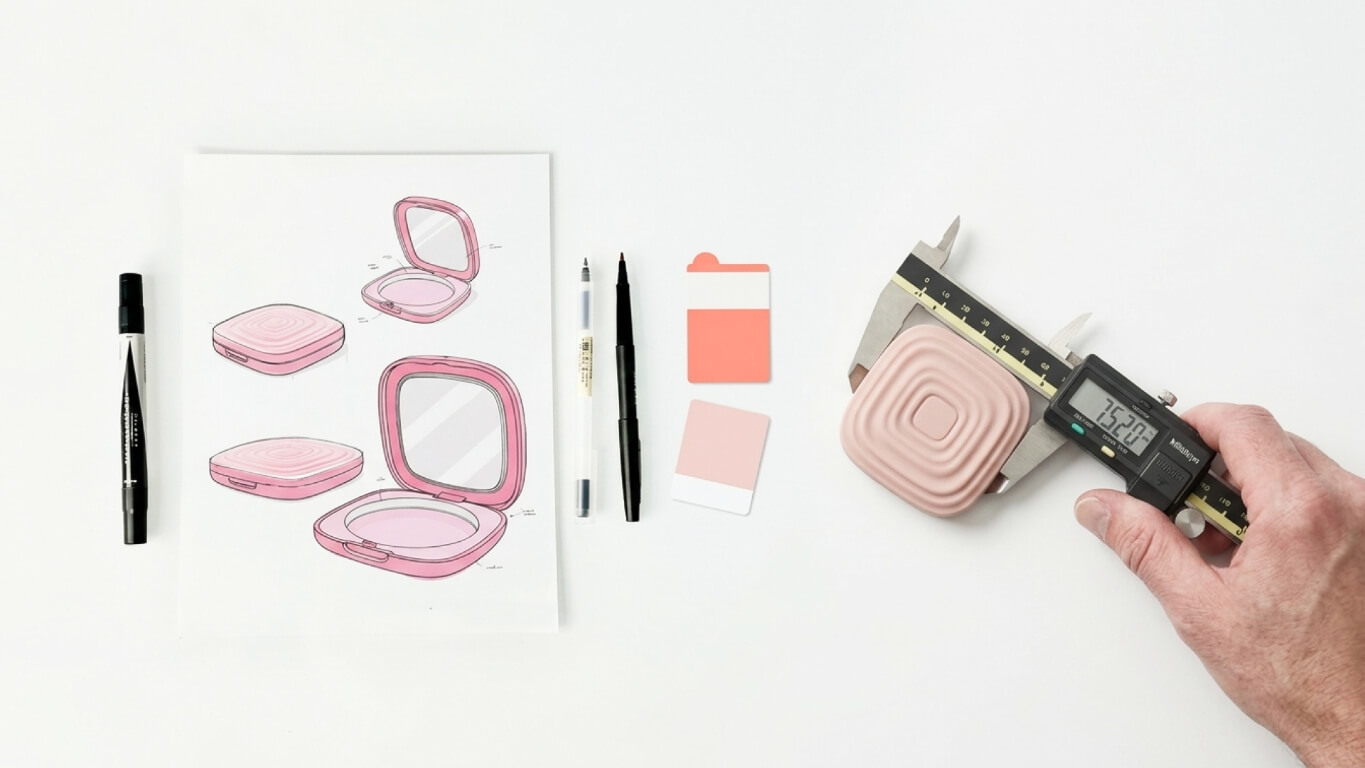
The biggest risk in custom packaging is producing something visually striking that cannot be reliably manufactured at scale. This is why Marino Belotti’s tailored compact solutions process treats packaging design as an engineering discipline as much as a creative one. Concepts are developed through sketches and moodboards, then tested against real constraints: wall thickness, hinge mechanics, mould feasibility and assembly tolerances. Photorealistic renderings and physical prototypes allow a brand to evaluate custom packaging before committing to production, reducing risk and shortening development timelines.
Packaging design decisions made at this stage also influence long-term flexibility. A well-engineered custom packaging base can often be adapted for future line extensions, new shades or seasonal variations without a full redesign, protecting the brand’s investment in tooling while keeping packaging design fresh across successive launches.
CMF choices that define a packaging design
Colour, material and finish, known in the industry as CMF, are where packaging design becomes tangible. Soft-touch coatings, glossy lacquers, matte surfaces and metallic effects each communicate a different brand personality, and custom packaging allows every one of these choices to be tailored precisely rather than selected from a generic catalogue. Marino Belotti’s product lines serve as a starting reference for proportions and mechanisms, while CMF selection personalises the surface story on top of that structural foundation.
Ultimately, custom packaging succeeds when packaging design and engineering move together rather than in sequence. A compact that looks exceptional in a rendering but fails in the hand, or opens awkwardly at the counter, undermines the very brand experience it was meant to elevate. Brands that treat custom packaging as a collaborative, iterative process, refining packaging design through prototypes and technical feedback, are the ones that end up with a compact that feels as considered as the formula it protects.
Timelines and expectations for a custom packaging project
One of the most common questions brands ask when starting a custom packaging project is how long the process takes from first brief to finished compact. In practice, timelines depend heavily on how much of the packaging design is genuinely new versus adapted from an existing base. A project built on a proven geometry, with custom CMF and decoration applied on top, can move considerably faster than one requiring an entirely original mould from scratch, since packaging design that starts from validated mechanics carries far less engineering risk.
Setting realistic expectations early also helps custom packaging projects avoid costly late-stage changes. Brands that involve their packaging design partner from the earliest creative discussions, rather than presenting a finished concept and asking for it to be reproduced exactly, tend to end up with a compact that is both closer to the original vision and easier to manufacture reliably at scale. Clear communication about volumes, launch dates and budget constraints allows custom packaging decisions around materials, decoration and tooling to be made with the full picture in view from day one.
Belotti has its roots in metal engraving and button production for the fashion industry. Follow us on Instagram
