

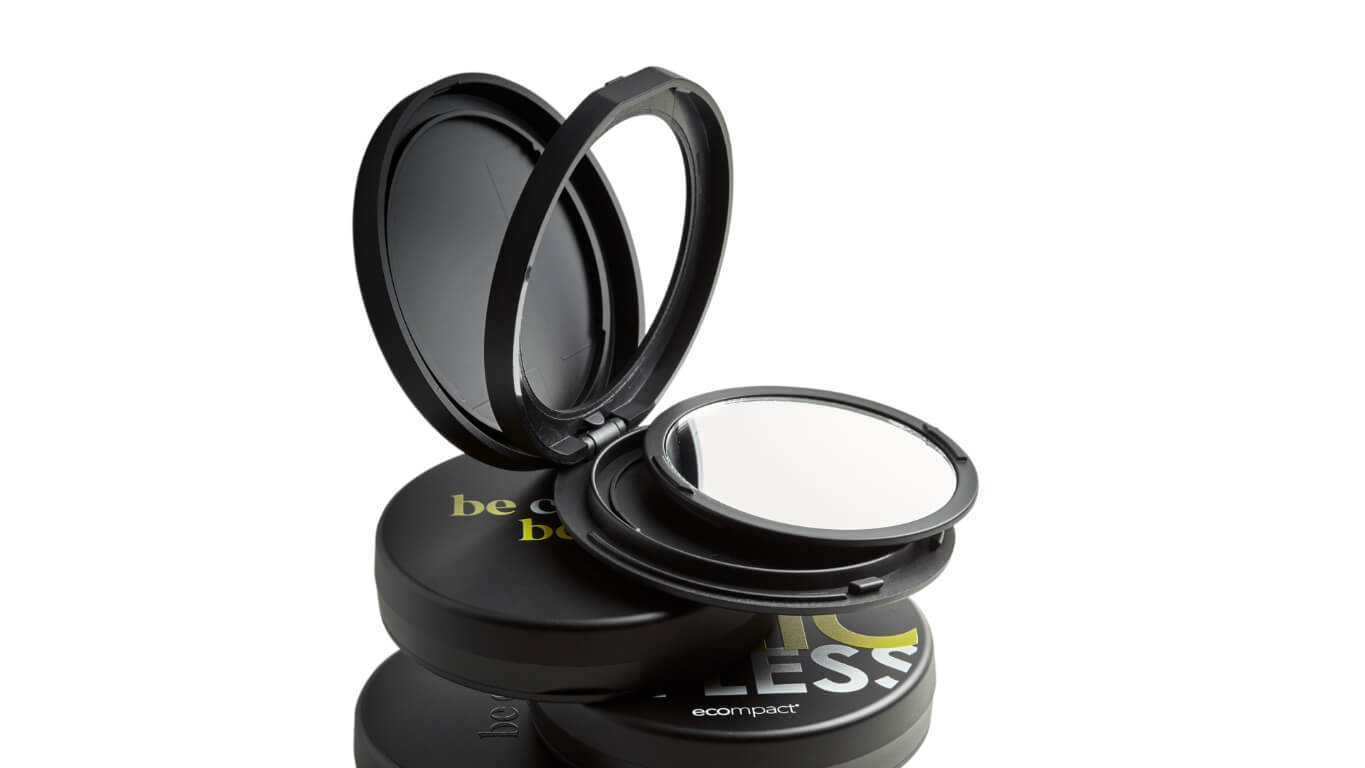
Sustainability has moved from a marketing claim to a design requirement, and sustainable cosmetic packaging now sits at the centre of how beauty brands plan new launches. For an industry built around small, precisely engineered objects like compacts, eco friendly packaging is not a matter of a single material swap but a series of interconnected decisions covering material choice, weight, manufacturing process and end-of-life.
Marino Belotti has structured its innovation strategy around sustainable cosmetic packaging for several years, recognising that beauty brands increasingly need suppliers who can document, not just claim, their environmental performance. This commitment was recognised with an EcoVadis Gold rating, an independent confirmation that the company’s approach to eco friendly packaging extends beyond individual products into its overall business practices.
What sustainable cosmetic packaging actually involves
Developing sustainable cosmetic packaging typically means working across several levers at once: refillable systems that extend the life of a single case, mono-material construction that simplifies recycling, and the use of recycled or bio-based content where formula compatibility allows. Eco friendly packaging also depends heavily on lightweighting, reducing the amount of material used per unit without compromising the mechanical performance a compact needs to survive daily use. Marino Belotti’s Ecompact line, built around the philosophy of doing more with less, is a direct expression of this approach to sustainable cosmetic packaging.
Because these decisions are interconnected, eco friendly packaging is most effective when addressed early in the design process rather than retrofitted onto an existing case. A refillable mechanism, for instance, influences hinge design, wall thickness and mould construction from the very beginning, which is why Marino Belotti’s engineering and design teams work on sustainable cosmetic packaging requirements alongside aesthetic and functional briefs, not after them.
Balancing eco friendly packaging with performance and aesthetics
A common misconception is that sustainable cosmetic packaging must compromise on look, feel or reliability. In practice, eco friendly packaging developed with the same engineering discipline applied to any other compact can match, or exceed, the performance of conventional solutions. Read more about the company’s broader innovation and sustainability approach, which combines refillable systems, mono-material components and efficient moulding processes without asking brands to sacrifice premium positioning.
For beauty brands evaluating suppliers, sustainable cosmetic packaging and eco friendly packaging are increasingly non-negotiable criteria rather than differentiators. Choosing a manufacturing partner that treats these requirements as integral to design and engineering, rather than as an afterthought, is what allows a compact to be both genuinely sustainable and commercially competitive over the long term.
Questions to ask a supplier about sustainable cosmetic packaging
Brands evaluating a potential partner for sustainable cosmetic packaging should look beyond marketing language and ask for specifics: which independent certifications or ratings support the supplier’s environmental claims, what percentage of recycled or bio-based content is realistically achievable for the components in question, and how refillability or mono-material construction is validated through real durability testing rather than theoretical design alone. A supplier able to answer these questions with documented evidence, rather than general reassurances, is far more likely to deliver eco friendly packaging that performs as promised once in market.
It is also worth asking how sustainability requirements are integrated into the design process itself. Suppliers that treat sustainable cosmetic packaging as a parallel workstream, addressed after the core design is finalised, tend to produce compromised results compared with those that build eco friendly packaging considerations into the very first concept discussions. This difference in process, more than any single material choice, is often what separates packaging that merely claims sustainability from packaging that genuinely delivers it. Brands that ask these questions early tend to reach a workable, verifiable sustainable cosmetic packaging solution far more quickly than those who treat eco friendly packaging as a late-stage add-on to an already finalised design.
Belotti has its roots in metal engraving and button production for the fashion industry. Follow us on Instagram