

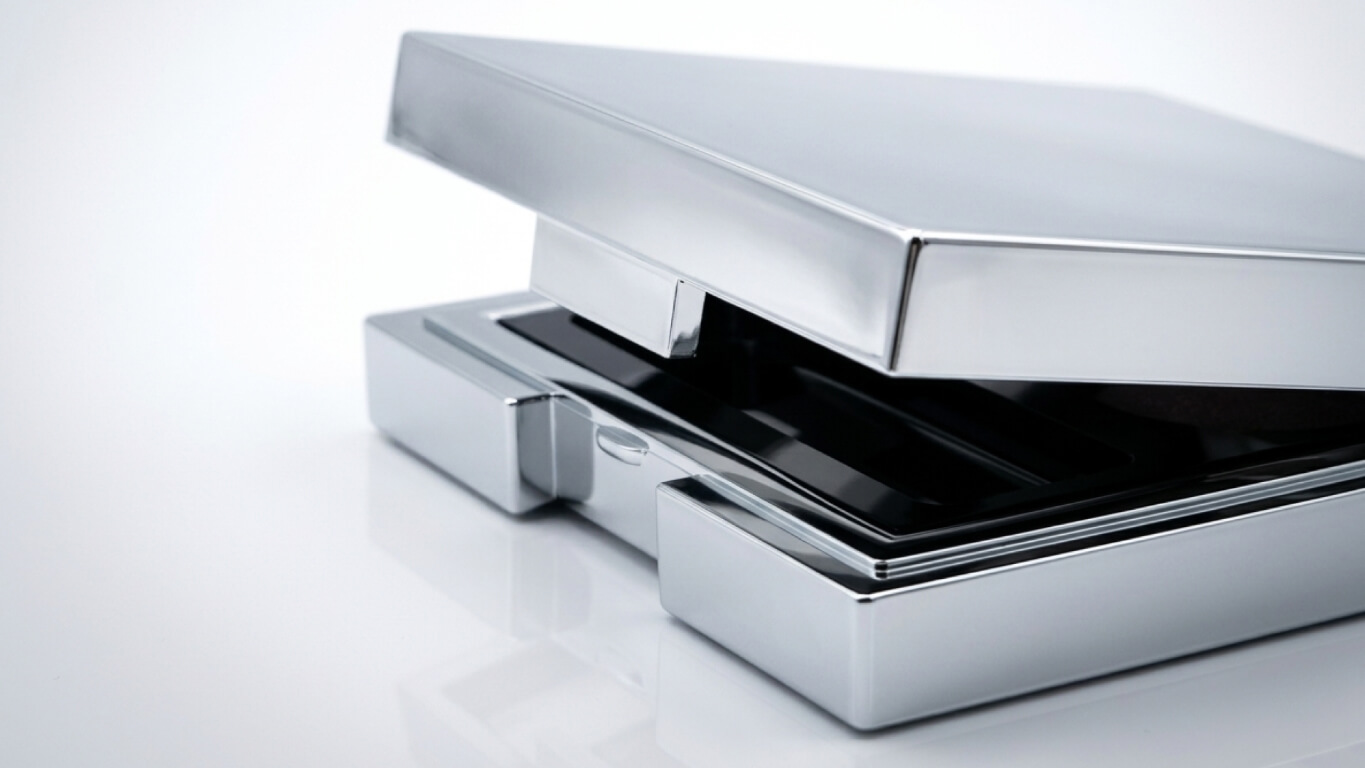
Cosmetic packaging is often judged first on appearance, yet the brands that succeed over time are the ones that understand it as a technical category with its own rules, tolerances and constraints. Good packaging for make up must protect delicate formulas, perform consistently across thousands of units and still communicate a brand’s identity within a few square centimetres of surface.
Marino Belotti has spent over four decades focused specifically on this category, developing cosmetic packaging for powders, poured formulas and multi-shade collections used by beauty brands across Europe and beyond. This specialisation means that decisions about packaging for make up are informed by direct experience with how formulas behave inside a case, how consumers open and close it thousands of times, and how the object needs to travel from factory to counter to handbag without losing its integrity.
The technical foundations of cosmetic packaging
Cosmetic packaging begins with structural choices that are invisible to the end consumer but decisive for performance: wall thickness, hinge geometry, closure tension and internal recess depth. Packaging for make up must also account for the specific formula it will contain, since a pressed powder, a baked texture and a poured cream each interact differently with the case that holds them. Marino Belotti’s product lines, spanning round, square and oval geometries, illustrate how the same category of cosmetic packaging can be adapted to dozens of different technical requirements while maintaining a coherent design language.
Because cosmetic packaging is manufactured at scale, consistency across production batches is just as important as the initial design. Internal quality control processes verify that every unit of packaging for make up meets the same standards for fit, finish and mechanical reliability, regardless of whether the order is a limited edition or a long-running core range.
Where cosmetic packaging meets brand identity
Beyond its technical role, cosmetic packaging is one of the most direct expressions of brand identity available to a beauty company. The shape, weight, sound of closure and surface finish of packaging for make up all contribute to a sensory impression that consumers associate, consciously or not, with the brand itself. This is why many companies choose to work with Marino Belotti’s tailored compact solutions team, developing cosmetic packaging that starts from an existing base or from an entirely original concept, refined through renderings and prototypes until it matches the brand’s vision precisely.
Understanding cosmetic packaging as a discipline that combines engineering, materials science and design allows brands to make better decisions earlier in development. Packaging for make up designed with this level of rigour tends to perform better commercially too, because it survives real-world use while continuing to look, and feel, exactly as intended.
Common mistakes when specifying cosmetic packaging
Brands new to developing their own cosmetic packaging sometimes underestimate how much formula behaviour affects case design. A poured formula that cures inside the case, for example, places very different demands on packaging for make up than a pressed powder filled after moulding, particularly around venting, mould release and internal surface treatment. Skipping formula compatibility testing at the design stage is one of the most frequent causes of costly rework later, when a cosmetic packaging solution that looked perfect on paper fails once real product is filled into it.
Another common oversight is treating packaging for make up as a purely visual decision, finalising colours and finishes before engineering has confirmed that the underlying structure is sound. Sequencing the process the other way, validating the mechanics of packaging first and then refining CMF details, tends to produce more reliable outcomes and fewer late-stage surprises when a new packaging for make up project moves from prototype to full production.
Belotti has its roots in metal engraving and button production for the fashion industry. Follow us on Instagram
