

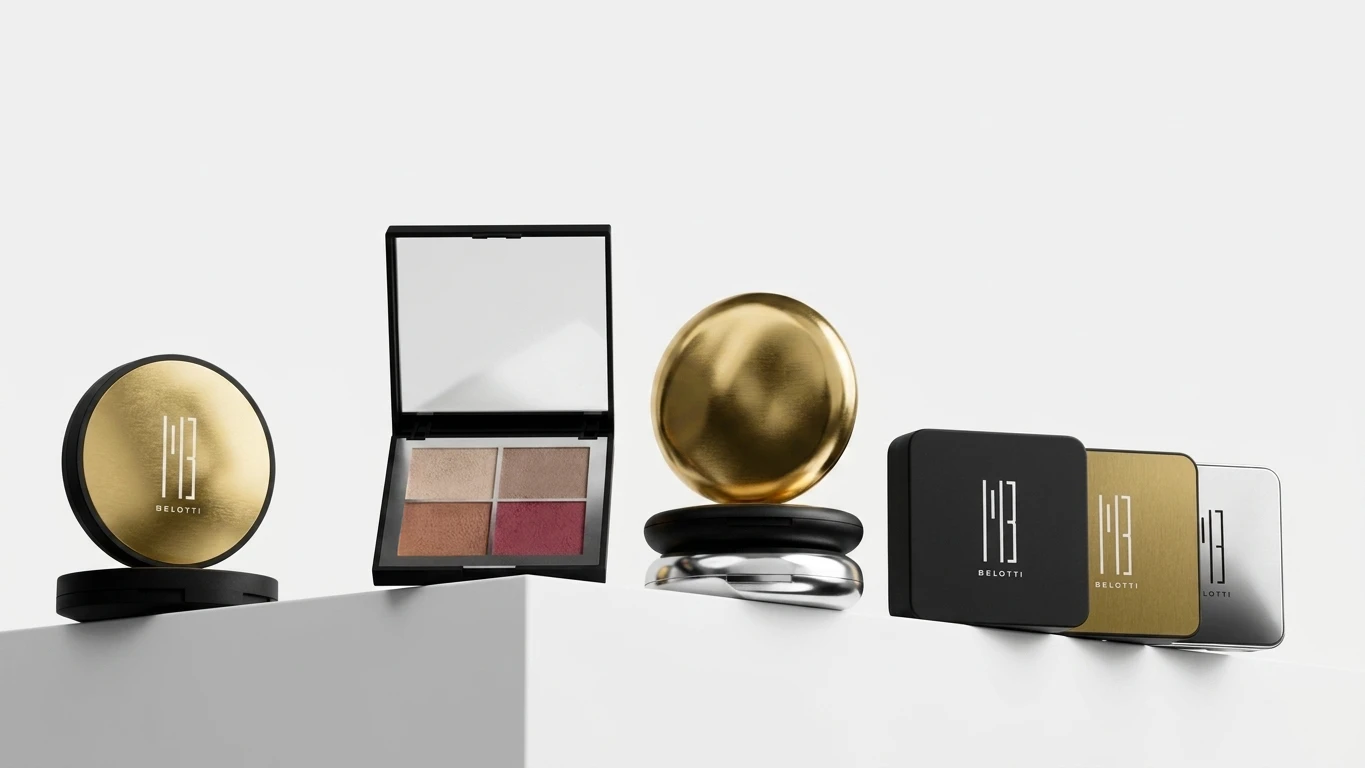
Compact packaging as an expression of brand identity
In the world of prestige beauty, compact packaging is much more than a container. It is the first physical touchpoint between brand and consumer, and a precise frame for textures, colours and gestures. Through the shape of a case, the weight in the hand and the sound of the closure, compact packaging quietly communicates the values of a makeup line.
Founded in 1979 near Bergamo, Marino Belotti has built its expertise around compact makeup, designing and producing high end cases entirely Made in Italy for international brands. Decades of focus on compact packaging allow the company to balance clean engineering with refined aesthetics and a distinctive sense of Italian craftsmanship. Each project is conceived as a dialogue between technical requirements and the emotional language of beauty.
For beauty brands, choosing the right compact packaging means defining how the product will be perceived in the hand, in the make-up pochette and at the point of sale. Shape, proportions, internal framing and decoration all contribute to a narrative that must remain coherent with the brand universe. Within this perspective, Marino Belotti has developed an extensive portfolio of compact makeup lines that translate different design languages into reliable industrial solutions.
A portfolio of compact makeup lines
Today the catalogue includes more than 700 SKUs organised into 14 upstream lines, covering the main categories of compact makeup for powders and poured formulas. Each line represents a specific design direction round, square, oval or rectangular and is available in multiple sizes and internal configurations. This structure helps brands navigate the universe of compact packaging through clear product families, making it easier to identify the ideal base for bronzers, highlighters, blushes, eyeshadows or face palettes.
Within this landscape, compact packaging is never a static element but a flexible platform. A single base can host different lids, heights and internal grids, allowing a variety of compact makeup creations from mono colour powders to multi shade kits. This modularity is essential for brands that want to build coherent ranges while differentiating product functions and price points. It also supports line extensions over time, as new shades or textures can be added without changing the overall identity of the packaging.
The result is a portfolio where compact makeup solutions can be scaled from limited editions to long term core ranges, keeping a consistent aesthetic grammar. Technical details such as hinge design, wall thickness and recess depths are engineered to ensure that each variation performs with the same level of precision.
From timeless rounds to architectural squares
Some product lines reinterpret the archetype of the round powder compact, while others adopt square or rectangular silhouettes with a more architectural profile. Afrodite and Diana, for instance, explore classic and lordly round shapes designed for face powders, poured formulas and baked textures. Their domed or higher lids give compact makeup a soft, iconic presence on the dressing table, emphasising volume and curvature in a balanced way.
On the other side, Proserpina and Venere represent the square soul of Marino Belotti compact packaging, with linear geometries and multiple lid options ranging from flat frame designs to more sculptural domed versions. These lines are ideal when compact makeup is meant to convey a graphic, contemporary attitude, dialoguing with fashion inspired colour stories and statement palettes. By working within a coherent system of dimensions and heights, brands can move fluidly between minimal, essential looks and more expressive, decorated interpretations.
Across both round and square families, the design language remains discreet and controlled, leaving space for formulas, shades and finishes to take centre stage. In this way, compact packaging becomes a silent architecture that supports, rather than competes with, the product.
Compact packaging for different makeup categories
Each product family within the portfolio is engineered around specific compact makeup categories. Certain configurations are optimised for single shade bronzers, others for duo blushes, still others for multi pan eyeshadow or face palettes. Internal cavities, refilling options and accessory spaces such as applicators or mirrors are designed to work in harmony with formula behaviour, from pressed powders to baked domes and poured creams.
Attention to the relationship between formulation and compact packaging ensures that opening gestures, product pick up and visibility of shades remain fluid and precise. Ergonomics plays a central role: hinges, closures and internal structures are calibrated to support professional use and repeated daily gestures, which is crucial for premium compact makeup that accompanies consumers over time. The objective is to create compact packaging that feels intuitive in the hand, with movements that are smooth, controlled and reassuring.
This category driven logic allows brands to build complete ranges where foundations, bronzers, highlighters and eye products share a common compact packaging language while responding to very different technical needs.
Tailored compact solutions and co creation
Beyond the standard catalogue, Marino Belotti’s Center of Excellence offers tailored compact solutions, where the starting point can be a line already present in the portfolio or a completely new shape developed together with the client. Through an integrated process that includes design, mould construction, injection moulding, decoration and assembly, the company supports brands in every phase of the compact packaging project.
This approach allows compact makeup to reflect the nuances of each brand: from soft touch finishes to galvanic effects, from engraved logos to 3D digital prints. Technical and creative teams work side by side to fine tune proportions, details and surfaces until the compact packaging fully embodies the desired character. When details make the difference, the compact becomes a refined frame that enhances formula, colour and gesture, shaping an elegant dialogue between object and identity.
